 The Oregon Coast to show picture; click anywhere else (Apple IOS: refresh page) to hide picture.
NOTE: Click on brown textThe Oregon Coast to show picture; click anywhere else (Apple IOS: refresh page) to hide picture.
CNC Control Switches
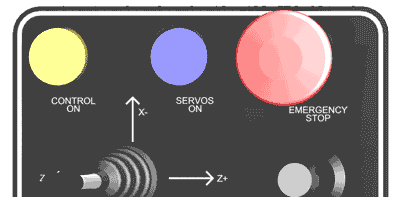
Operator's Station
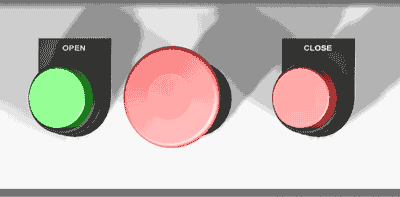
If the servos are not coming on, the most common reason is a bad Emergency stop contact, either in the control E‑stop button or the E‑stop on the Operator's Station.
If the E-Stops are disengaged, and you have no loader connected to your OmniTurn, you can quickly check the entire E‑stop string with an ohmmeter.
Two tests are required:
Ommeter Test 1: With the power off, make sure the E‑stop buttons are not pushed in and measure the resistance from the striped end of the diode next to 1CR to the black wire on the top of the blue contact block on the Servos On switch. This should be about 80 ohms. This measures through the 1CR relay coil and the E‑stop string to the Servos On switch. (See schematic).
Reference schematic
Measure 80 ohms

Reference Schematic (Red)

Ommeter Test 2: With the power off, make sure the E‑stop buttons are not pushed in and measure the resistance from the CRDY test point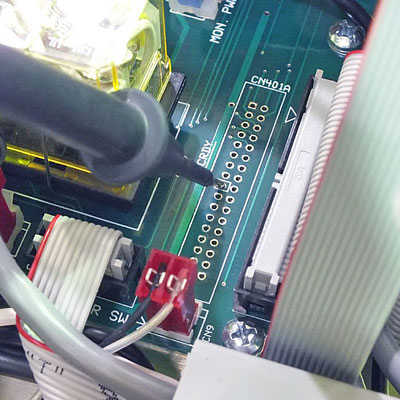
Ohmmeter Lead at CRDY. in the middle of CN401A to the brown wire on the bottom of the blue contact block on the Servos On switch. This should be close to 0, say less than 5 ohms. This measures through the entire E‑stop string to the bottom of Servos On switch. See schematic
Ohmmeter Lead at CRDY..
Measure 0 ohms

Measure 0 ohms (Press Servos On)

Measure 0 ohms (Press Servos On)
For these tests, you will leave one ohmmeter lead at CRDY (CN401A-17)
Ohmmeter Lead at CRDY., and "walk" the other lead through the switch terminals per the picture below, starting at #6 and going to #1. See schematic
Ohmmeter Lead at CRDY.. When the OL (open circuit) condition changes to zero ohms you have found the bad contact. Refer to the list below the picture.


You will need a voltmeter set to DC volts. This first test is necessary if the ohmmeter tests 1 & 2 were both good, but your servos still don't turn on. This test checks for the "Computer Ready" (CRDY) signal.
Turn the control on: stop at the screen that shows the "Servos off or external halt.." message.
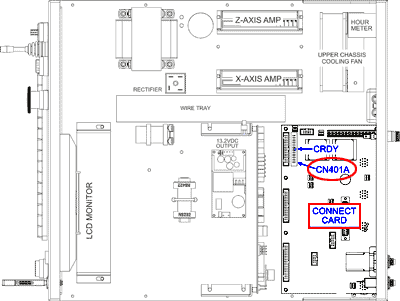
There are more voltage tests below, but they just duplicate the ommeter tests.

If the CRDY voltage is about 12.5VDC, and the ohmmeter tests measure good, the servos should come on. Leave the RED meter lead at the lead at the stripe end of the diode, and touch the BLACK meter lead to each of the terminals on the E‑stop and Control On switches as shown in the image below. Start at #1, and check for about 12.5VDC. Reference the list below.

If the voltage is NOT about 12.5VDC, at CN401-17, the 5AX card isn’t pulling the CRDY pin down, possibly because of a bad output driver chip, or there’s a bad connection in the CN401 ribbon cable.
To check the ribbon cable, turn off the CNC, then unplug ribbon cable 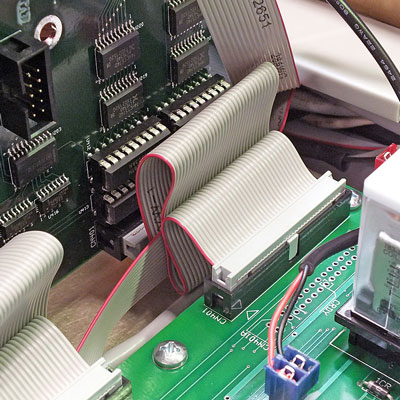
CN401 Ribbon Cable between 5AX and Connect Card
between CN401 on 5AX card and connect card.
NOTE: Current 5AX cards, shipped after May, 2025 are smaller, so the ribbon cable 
CN401 Ribbon Cable between 5AX and Connect Cardis easier to access.
Examine the connectors to insure the ribbon is securely in place. unplug and replug both ends, power up the CNC and see if you can turn on the servos. If not, recheck the voltage at CN401-17 as above: RED meter lead at the lead at the stripe end of the diode, and BLACK meter lead at CN401-17).
Meter lead at CN401 CRDY.
If still not 12.5VDC, you will need to replace the driver IC on the 5AX board.
If your CNC is equipped with first generation 5AX card, 
First Generation 5AX Cardthe driver IC is U417, 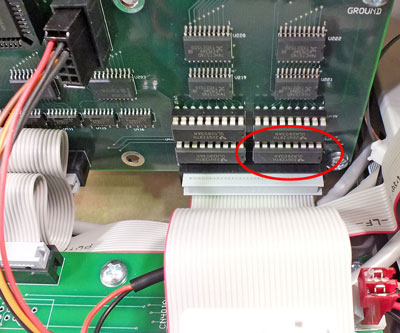
Driver IC U417and the spare is U414.
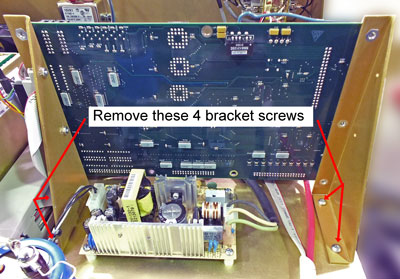
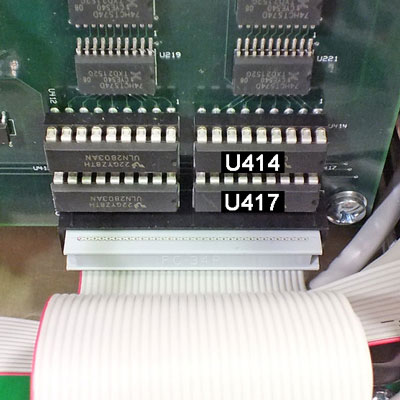
If your CNC is equipped with second generation 5AX card, 
Second Generation 5AX Cardthe driver IC is U307, 
Driver IC U307and the spare is U308.

When removing the IC's from their sockets, be careful not to bend the leads- work them out gradually by slipping a small screwdriver or similar tool under one end, then the other. When plugging them into their sockets make sure that none of the leads get bent.
Replacement driver IC UL2803A is available at DigiKey.com).